

Discover Your Perfect Vape Cartridge: A Complete Guide
- Shawn Dabster

- Apr 30
- 13 min read

Choosing the Right Vape Cartridge: A Comprehensive Guide to Selecting High-Quality Cannabis Vape Products
A vape cartridge is a prefilled or refillable container of cannabis extract designed for inhalation through a battery-powered device, and choosing the right cartridge affects safety, flavor, and therapeutic outcome. This guide explains cartridge types, oil and extract varieties, hardware compatibility, effect-driven selection, and quality checks so you can make informed purchases and use products responsibly. Many users face confusing labels, incompatible batteries, and unclear extraction claims; this article resolves those pain points by describing technical differences and practical decision criteria. You will learn how to compare 510-thread, pod, disposable, and refillable systems, distinguish distillate from live-resin or full-spectrum oils, evaluate coil and tank materials, map cannabinoids and terpenes to desired effects, and verify lab testing and COAs. Throughout, the emphasis is on safety, flavor preservation, and predictable potency with actionable lists, comparison tables, and vendor-aware guidance that aligns with current research and consumer standards. The article integrates brief, clearly labeled references to VapeMeds’ product categories and quality commitments where relevant, while keeping education as the primary focus.
What Are the Different Types of Vape Cartridges and Their Benefits?
A vape cartridge is a small assembly that contains cannabis oil, a mouthpiece, a heating element, and a connector that mates with a battery; different cartridge types trade off compatibility, convenience, flavor, and cost. Understanding the major categories—510-thread cartridges, pod systems, disposable pens, and refillable cartridges—helps you match device form factor to use case and priorities. This section defines each type, highlights typical benefits and limitations, and provides a compact comparison to guide purchase decisions. After clarifying types, the next subsections explain universal compatibility and when to choose pods or disposables based on lifestyle and flavor goals.
Different cartridge types and their core benefits:
510-thread cartridges: Wide compatibility with many batteries; ideal for users who want device flexibility and long-term cartridge options.
Pod system cartridges: Integrated with a specific battery ecosystem; offer convenience, compact design, and often leak-resistant seals.
Disposable vape pens: All-in-one convenience with no maintenance; best for trialing strains or travel without hardware commitment.
Refillable cartridges: Reusable tanks that reduce waste and allow custom filling; preferred by experienced users who mix oils or use concentrates.
These options map to common consumer priorities and clarify why choice matters when flavor, portability, and sustainability differ across formats. The next subsection examines how a 510-thread standard supports broad compatibility and what to check when pairing batteries with cartridges.
Introductory comparison table: cartridge attributes and practical tradeoffs.
Cartridge Type | Typical Compatibility | Primary Benefit | Common Tradeoff |
510-thread cartridges | Most 510 batteries | Device flexibility and wide aftermarket support | Requires compatible battery selection |
Pod system cartridges | Specific pod/battery pairs | Compact design, ease of use, reduced leaks | Limited to brand ecosystem |
Disposable vape pens | Integrated battery + cartridge | No setup or maintenance, immediate use | Not refillable, generates waste |
Refillable cartridges | Refillable tanks with adapters | Cost-efficient over time, customizable | Requires user maintenance and care |
This comparison clarifies how function follows form when selecting a cartridge type. The next section drills into the 510-thread standard and why it remains a common baseline for compatibility.
How Do 510-Thread Cartridges Ensure Universal Compatibility?
The 510-thread standard is a common mechanical and electrical connector that allows a wide range of cartridges to mate with many batteries, and it creates a predictable platform for pairing oils with power sources. Mechanically, the threaded connector centers the cartridge and provides electrical contact; electrically, the battery provides regulated voltage to heat the coil or atomizer inside the cartridge. The advantage is interchangeability—users can mix and match cartridges and batteries from different manufacturers—while the limitation is that not all 510 devices offer the same voltage profiles or safety protections. When selecting a battery for a 510 cartridge, prioritize regulated devices with short-circuit protection and voltage control if you intend to adjust output to match oil viscosity. Understanding this threading standard leads naturally to considering battery voltage and how it affects vaporization and flavor preservation.
What Are the Advantages of Pod System and Disposable Vape Cartridges?
Pod systems and disposable cartridges deliver different value propositions that suit distinct user behaviors and preferences, emphasizing convenience and low maintenance. Pod systems pair proprietary cartridges with compact batteries and are useful for discreet use, consistent draw resistance, and minimal user setup; they often appeal to brand-loyal customers who prioritize a seamless experience. Disposable vape pens provide fully integrated oil and battery assemblies that are ready out of the box, which suits beginners or travelers who prefer zero upkeep and predictable single-use performance. The main tradeoffs are that pod systems restrict cross-brand compatibility and disposables create more waste and lack refill flexibility; users who value flavor depth and long-term cost-effectiveness may prefer 510-thread cartridges or refillables. Given these distinctions, the following section explains the different cannabis oil and extract types found inside cartridges and how those oils influence the choice of cartridge format. Disposable cartridges are a key focus of this analysis.
How to Understand Cannabis Oil Types in Vape Cartridges?

Cannabis oil types include distillate, live resin, live rosin, and full-spectrum extracts, and each is defined by its extraction method, flavor profile, and the degree to which terpenes and minor cannabinoids are preserved. Extraction choices determine viscosity, terpene presence, and entourage-effect potential, which in turn influence which cartridge and coil types deliver the best flavor and vaporization. This section defines the main extract classes, compares their characteristics in a compact table, and then discusses how cannabinoids and terpenes shape subjective effects and sensory experience. After the extract definitions, a brief, educational product mapping shows how retail cartridge categories typically align with those oil types, with a short vendor note about quality commitments.
Introductory table comparing extract types by method and outcome.
Extract Type | Extraction Method | Characteristic / Benefit |
Distillate | Solvent-based refining and fractionation | High potency and purity; neutral flavor; versatile for dosing |
Live Resin | Hydrocarbon extraction from fresh-frozen plant material | Preserves terpenes and aroma; flavorful, pronounced entourage effect |
Live Rosin | Heat-and-pressure solventless from fresh plant | Solventless profile with rich terpene retention; premium flavor |
Full-Spectrum Extract | Broad extraction retaining minor cannabinoids and terpenes | Offers entourage effect and nuanced effects; variable viscosity |
This table underscores that flavor preservation and entourage potential differ significantly across oils, and consumers should choose oils that match their flavor and effect priorities. Next, the article maps typical product categories to these oil types and notes how a vendor’s quality commitments intersect with extract selection.
VapeMeds product-context note: VapeMeds offers a range of cannabis vape cartridges and disposables that align with these extract categories, emphasizing high quality, purity, and potency across its product lineup. For consumers comparing oil types, looking for vendors that state extraction methods and offer lab results helps verify terpene retention and solvent reporting. This vendor-focused point prepares readers for a deeper dive into cannabinoid and terpene influences in the next subsection.
What Are Distillate, Live Resin, Live Rosin, and Full-Spectrum Extracts?
Distillate is created by refining crude extract to isolate cannabinoids—typically yielding a high-THC or high-CBD product with reduced terpenes—so it offers consistent potency and a neutral flavor profile. Live resin is made from fresh-frozen plant material using hydrocarbon solvents to capture volatile terpenes, producing a fragrant, flavorful oil prized by flavor-focused consumers. Live resin uses heat and pressure on fresh plant material in a solventless process, delivering a clean profile with retained terpenes and a reputation for premium flavor and solvent-free perception. Full-spectrum extracts aim to preserve a broad array of cannabinoids and terpenes, supporting the entourage effect for nuanced therapeutic outcomes, but their viscosity and flavor can vary with starting material and post-processing. Understanding these distinctions helps consumers match extraction attributes to desired sensory and therapeutic results.
How Do THC, CBD, and Terpenes Influence Effects and Flavor?
THC primarily delivers psychoactive effects that range from uplifting to sedating depending on dose and cannabinoid context, while CBD is non-intoxicating and modulates THC’s effects and can support relaxation or reduced anxiety at certain ratios. Terpenes such as myrcene, limonene, and caryophyllene contribute characteristic flavors and may modulate subjective effects: myrcene often associates with sedative notes, limonene with uplifting citrus tones, and caryophyllene with spicy notes and potential anti-inflammatory signaling. The ratio of THC to CBD, the presence of minor cannabinoids, and terpene concentration collectively shape the cartridge’s overall effect profile and sensory experience. Knowing these interactions allows users to select cartridges for target outcomes like energy, relaxation, or balanced experiences, which the next major section will map to hardware and compatibility considerations.
Research further supports that specific cannabis terpenes can significantly enhance and modulate the therapeutic effects of cannabinoids like THC.
Cannabis Terpenes Enhance Therapeutic Effects Our results strongly support a modulatory effect of some of the selected cannabis terpenes on THC-induced CB1 receptor activation. For enhanced therapeutic effects, desired compositions are attainable by enriching extracts with specific terpenes. Selected cannabis terpenes synergize with THC to produce increased CB1 receptor activation, AM Eyal, 2023
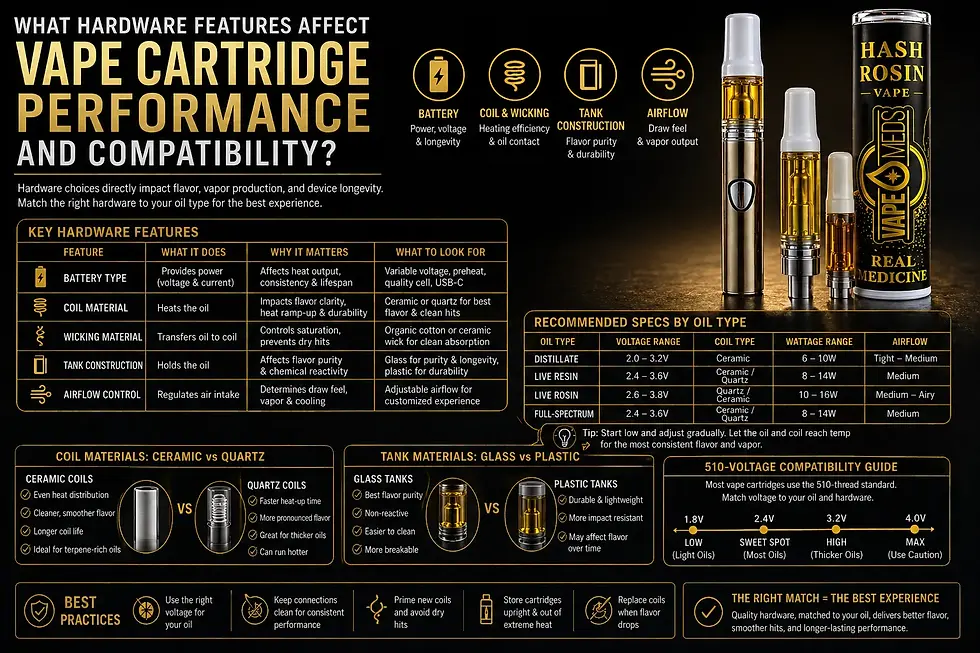
What Hardware Features Affect Vape Cartridge Performance and Compatibility?
Hardware choices—battery type, coil material, tank construction, and airflow—directly affect flavor fidelity, vapor production, and device longevity; matching hardware to cartridge oil type maximizes user satisfaction. Batteries determine available voltage and current, coils and wicking affect how oil contacts the heating element, and tank materials (glass versus plastic) can influence flavor reactivity and longevity. This section summarizes key hardware features in a compact table, provides practical specs recommendations, and explains how coil and tank materials interact with different oils. After this hardware overview, the H3 subsections address voltage compatibility for 510-thread systems and compare ceramic versus quartz coils and glass versus plastic tanks in more detail.
Hardware features and recommended specs table.
Hardware Component | Feature | Recommended Specs |
Battery | Voltage control and safety | Regulated 510 batteries with short-circuit protection; adjustable 2.4–4.2V for varying oils |
Coil Material | Heat response and flavor | Ceramic for even heating and flavor preservation; quartz for fast ramp-up and clean hits |
Tank Material | Reactivity and purity | Glass preferred for inertness and flavor; high-grade plastics for durability but monitor flavor changes |
This summary helps buyers choose components that preserve terpene profiles and avoid burnt tastes. Next, the first H3 explains how battery voltage and 510 compatibility affect daily use and troubleshooting.
VapeMeds hardware note: For customers seeking compatible batteries or accessories, VapeMeds sells 510-compatible hardware and emphasizes selecting batteries that match cartridge requirements to maintain purity and consistent performance. This brief vendor mention supports actionable next steps without replacing the technical guidance.
How Do Battery Voltage and 510-Thread Compatibility Impact Usage?
Battery voltage determines how quickly an oil vaporizes and influences throat hit, flavor fidelity, and risk of burning; lower voltages tend to preserve delicate terpenes while higher voltages increase vapor and may sharpen throat hit. Matching voltage to oil viscosity is crucial: thicker live-resin or full-spectrum oils often require slightly higher settings for consistent draw, while thin distillates vaporize effectively at lower voltages. Signs of improper voltage include a burnt or metallic taste, poor vapor production, or leaking from seals due to overheating; troubleshooting begins with lowering voltage, ensuring clean contacts, and confirming 510 threading is tight but not over-torqued. Choosing a regulated 510 battery with adjustable voltage and basic safety protections provides flexibility across cartridge types and supports consistent, safe vaping. Understanding these voltage dynamics naturally leads to material choices in coils and tanks and how they affect flavor.
What Are the Differences Between Ceramic and Quartz Coils or Glass and Plastic Tanks?
Ceramic coils heat evenly and absorb oil into porous material for gentle vaporization, which often preserves terpene complexity and reduces hotspots that cause burnt flavor. Quartz coils heat rapidly and deliver purer, more immediate hits with lower residual taste, which some users prefer for clarity and fast ramp-up; however, quartz may not retain flavor as richly as ceramic over prolonged sessions. Glass tanks are chemically inert and do not leach flavors, making them the preferred option for flavor-conscious users and for preserving full-spectrum or live resin profiles; plastic tanks are lighter and more impact-resistant but can interact with certain terpenes and degrade over time if exposed to solvent-rich oils. Maintenance and durability differ as well: ceramic elements can last long but require careful priming and avoiding dry hits, while quartz and glass demand gentle handling to prevent fractures. These material tradeoffs guide users toward gear that aligns with their priority—maximum flavor, rapid vapor, or practical durability—which sets up the next section on choosing cartridges for specific effects and wellness goals.
However, despite advancements in coil and tank materials, studies indicate that metal components within vaping devices can still introduce contaminants into the vapor.
Cannabis Vape Safety: Metal Contamination from Devices Vaping cannabis liquids is a convenient method of cannabis consumption, and is considered to be a less harmful alternative to smoking cannabis. However, vaping cannabis carries its own health risks, with many uncertainties, especially concerning the presence of metal particles in vape liquids. The results indicated that metals from the vaping device components, cobalt (Co), nickel (Ni), and zinc (Zn) significantly contributed to within-batch variability. All samples produced aerosols containing metal particles of Co, Cr, Ni, lead (Pb), Sn, and Zn. The elemental composition of the metal components in the cartridges matched the detected particles, providing strong evidence that cannabis vape liquids are contaminated by the metal components of vaping devices. Tracking metal presence in cannabis vaping products from source to inhalation, Z Gajdosechova, 2025
How to Choose Vape Cartridges for Desired Effects and Wellness Benefits?
Choosing cartridges for energy, relaxation, pain relief, or sleep starts with identifying cannabinoid ratios, terpene profiles, and extract types that align with the intended outcome; targeted selection increases the likelihood of predictable results. Sativa-leaning or high-THC profiles with uplifting terpenes like limonene typically support energy and mood elevation, whereas indica-leaning profiles with myrcene and linalool tend toward relaxation and sedation. For wellness applications—pain, anxiety, sleep—combinations of THC, CBD, and calming terpenes often provide complementary effects, and full-spectrum extracts can enhance outcomes via the entourage effect. This section maps practical cartridge archetypes to effects, offers dosing and titration guidance, and finishes with a short shop-recommendation bridge that points to relevant product categories for purchase. After effect mapping, H3 subsections present specific recommendations and how cannabinoid profiles target common conditions.
Practical tips list: selecting cartridges for intent
Choose oils with preserved terpenes for nuanced effects and robust flavor.
Prefer full-spectrum or live-resin for therapeutic synergy when targeting pain or sleep.
Start with low THC doses and titrate slowly for anxiety-sensitive users to avoid overstimulation.
These actionable tips help users translate effect goals into cartridge choices. The following subsection gives concrete cartridge profiles for energy, relaxation, and balance.
Which Cartridges Are Best for Energy, Relaxation, or Balanced Experiences?
For energy and focus, look for sativa-leaning or terpene-forward cartridges with uplifting terpenes such as limonene and pinene; light, terpene-rich live resin or full-spectrum extracts often support bright flavor and active effects. Relaxation-leaning cartridges typically emphasize myrcene, linalool, and higher CBD-to-THC ratios or indica-dominant cannabinoid profiles; live rosin or full-spectrum extracts with calming terpenes can provide smoother onset and more restorative subjective effects. Balanced or hybrid cartridges aim for moderate THC and CBD interplay with a mixed terpene bouquet to deliver moderate elevation without heavy sedation; distillates blended with curated terpenes can achieve consistent balanced experiences. Begin dosing conservatively—one inhalation, wait several minutes, and titrate slowly—so users can find the minimal effective dose for their intended activity or wellness goal. This profiling naturally leads to evidence-informed mappings for specific conditions like pain, anxiety, or sleep.
How Can Specific Cannabinoid Profiles Target Pain, Anxiety, or Sleep Relief?
For pain relief, combinations of THC with CBD and anti-inflammatory-supporting terpenes such as caryophyllene can provide analgesic effects while moderating psychoactivity; full-spectrum extracts may enhance efficacy via multiple minor cannabinoids. Anxiety-focused approaches emphasize lower THC doses or CBD-dominant ratios with uplifting terpenes like limonene to reduce paranoia risk and promote calm alertness. For sleep support, higher myrcene and linalool presence combined with moderate THC and a calming CBD complement often produce sedative effects suitable for nighttime use; dose timing and environment are important to avoid residual next-day effects. Clinically, conservative titration and consultation with a healthcare provider are recommended for therapeutic use, and users should avoid mixing with alcohol or other sedatives. These mappings show how biochemical profiles translate to outcomes and prepare readers for safety and quality checks in the following section.
Shop recommendations bridge: For readers ready to purchase, consider cartridge and disposable categories sold directly by vendors that emphasize transparent extraction methods and lab-backed potency; VapeMeds’ product categories include a range of cartridges and disposables aligned with live-resin, live rosin, distillate, and full-spectrum oils, presented with the company’s stated focus on high quality, purity, and potency.
What Quality and Safety Factors Should You Consider When Buying Vape Cartridges?
Quality and safety hinge on third-party lab testing, readable Certificates of Analysis (COAs), hardware integrity, and reputable supply chains; verifying these factors reduces exposure to contaminants and ensures potency matches labeling. Key checks include confirming COAs for pesticides, solvents, and heavy metals, reviewing cannabinoid potency results, and ensuring the vendor discloses extraction methods and ingredients. This section provides a concise checklist for COA interpretation, an EAV table summarizing lab-tested metrics, and a short vendor trust paragraph describing how to find lab results. After outlining testing essentials, the H3 subsections explain why COAs matter and summarize VapeMeds’ stated commitments to purity, potency, and direct sales.
Indeed, robust quality control standards are paramount to protect consumers from harmful contaminants and ensure product integrity across all cannabis formats, including vapes.
Cannabis Product Quality Control & Safety Standards It is imperative both healthcare providers and patients are educated on all aspects of cannabis treatment, including product safety and quality control. There are a number of quality control variables to consider when choosing medical cannabis products including contaminants, microorganisms, and pesticides. Quality control standards reduce or eliminate exposure to harmful chemicals and contaminants such as pesticides, extraction solvents, microorganisms, diluents, and fillers. These may be in a wide range of potential products which patients are considering or already using, including dried flower, oils, and concentrated products such as vapes. These are important considerations when selecting cannabis products and should not be overlooked by healthcare providers, patients, and cannabis consumers in general. Healthcare providers should be aware of which products patients are using and carefully inspect labelling. Quality control is most stringent for products that are obtained from a legal, licensed, and regulated source. Product safety and quality control, CA MacCallum, 2021
Essential buying checklist:
Request or review a recent Certificate of Analysis showing cannabinoid potency and contaminant screens.
Confirm extraction method and absence of added cutting agents or additives on product labeling.
Prefer inert tank materials and reputable coil types (ceramic or quartz) to reduce reactivity.
Choose vendors that publish lab results and provide clear product sourcing or extraction information.
Following this checklist helps purchasers reduce risk and supports predictable product performance. The next table lays out the primary lab metrics consumers should check on COAs.
Metric Tested | What Is Measured | Why It Matters |
Cannabinoid Potency | THC, CBD, minor cannabinoids levels | Verifies dosing and product label accuracy |
Residual Solvents | Presence of extraction solvents | Ensures solvent removal and consumer safety |
Pesticides | Agricultural chemical residues | Protects against harmful contaminants |
Heavy Metals | Lead, arsenic, cadmium, mercury | Prevents toxic exposure through inhalation |
Understanding these metrics empowers shoppers to interpret COAs and identify red flags quickly. Next, the final subsection summarizes why lab testing is essential.
Why Are Lab Testing and Certificates of Analysis Essential?
Third-party lab testing and Certificates of Analysis verify that labeled potency, terpene content, and contaminant absence reflect what’s in the cartridge, providing independent assurance beyond vendor claims. COAs list specific assay results—cannabinoid profiles, terpene panels, residual solvents, pesticides, and heavy metal screens—and allow consumers to confirm that products meet safety thresholds and potency expectations. Red flags on a COA include missing tests, out-of-range solvent or pesticide levels, or potency results that diverge dramatically from the label; when encountering those, avoid the product or request clarification from the vendor. Learning to read COAs reduces risk and improves confidence in product selection, and the following subsection explains how a vendor’s stated commitments factor into trust decisions.
How Does VapeMeds Ensure Purity, Potency, and Brand Trust?
VapeMeds is described as focusing on high-quality, pure, and potent cannabis vape products, offering a range of cartridges and disposables sold directly via its website and positioned toward wellness and elevated experiences. According to available vendor information, VapeMeds emphasizes product purity by aligning product categories with extract types and by positioning potency as a consistent, quality-controlled attribute across its lineup. For transparency-minded shoppers, VapeMeds indicates that lab results and Certificates of Analysis are available through its product information channels, which helps verify safety and composition before purchase. These vendor statements supplement the technical and safety guidance in this guide and provide a practical way for consumers to move from learning to purchasing while keeping quality and safety at the forefront.
1. Verify COAs: Confirm that the vendor posts recent, third-party lab results for each SKU.2. Match extraction to preference: Choose live-resin or live rosin for flavor and full-spectrum for therapeutic synergy.3. Check hardware compatibility: Use regulated batteries compatible with 510 threading for safety and performance.

Comments