


THC & The Teenage Mind: What the Science Actually Says: Cut through the myth. Understand the facts. Choose awareness.


Introduction
Let’s be real: cannabis is everywhere. Among teens especially, it’s part of the scene. But what too few people talk about is how the active compound — Delta‑9‑tetrahydrocannabinol (THC) — interacts with a brain that isn’t done building yet. If you’re under 25 (which includes many teens), the decisions you make now can echo into your future. At VapeMeds we believe understanding those echoes matters.
The Science: THC + The Developing Brain
A. A critical window
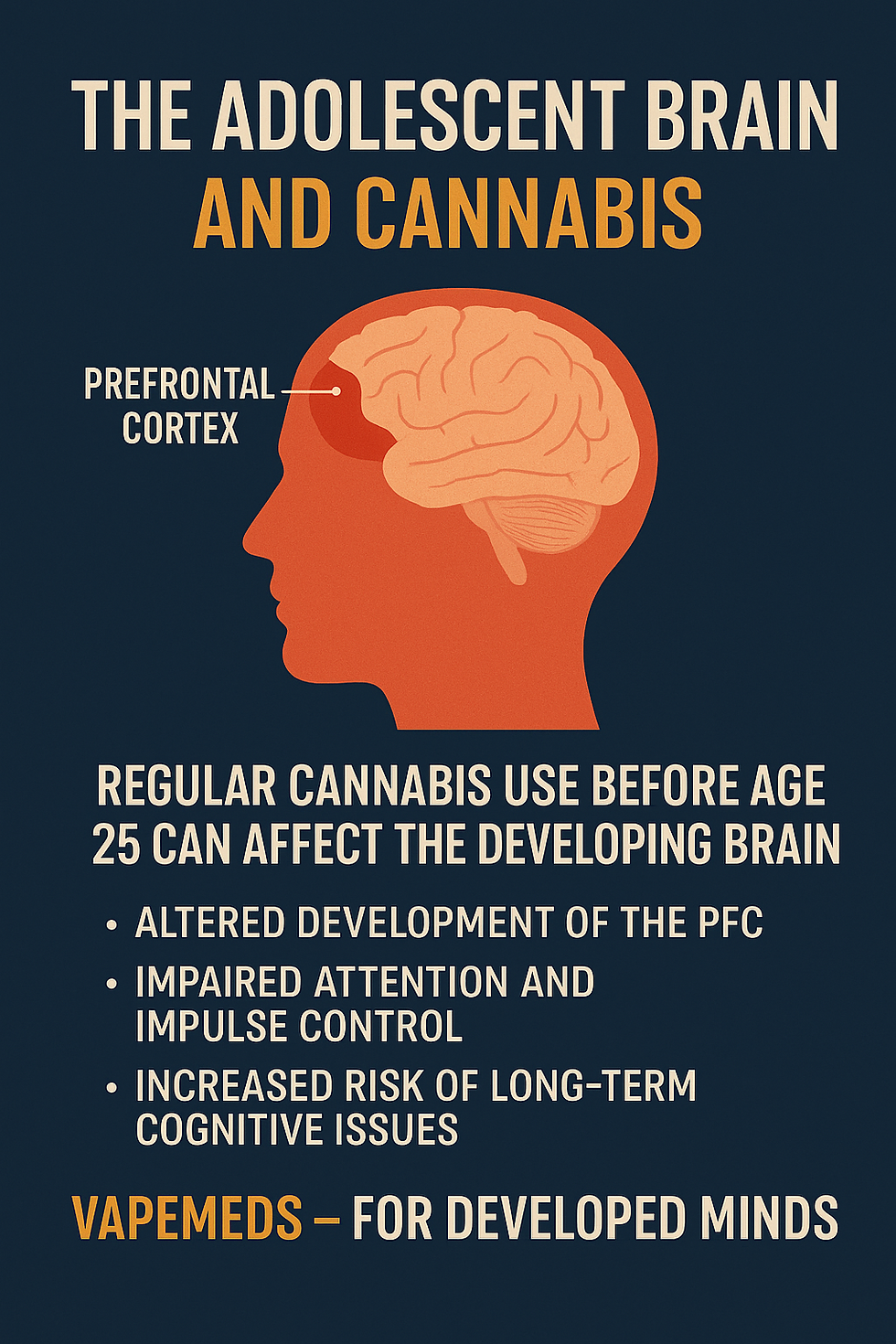
Adolescence isn’t just “teenage years” by social definition — biologically, it’s a time of serious brain construction: synapses being formed and pruned; myelination ramping up; circuits being fine-tuned. PMC+3PMC+3Frontiers+3 The brain regions most affected? Key front-end executive zones: the prefrontal cortex (PFC), orbitofrontal cortex, and the network nodes that help you plan, inhibit impulses, stay focused and make decisions. PMC+3PMC+3psych.hms.harvard.edu+3
B. How THC intervenes
THC mimics or interferes with the brain’s natural endocannabinoid system (ECS) — which plays a role in brain development: guiding neuronal migration, shaping synapses, modulating connectivity. MDPI When THC is introduced during adolescence, research shows possible disruptions to neural circuitry, altered synaptic pruning, changes in white-matter development, and even structural alterations in the PFC. PMC+3PMC+3JAMA Network+3
C. Evidence of long-term effects
Teens who used cannabis heavily show reduced connectivity between key frontal regions and poorer performance in cognitive tasks. PMC
Longitudinal and review studies conclude: “adolescence is a sensitive period during which cannabis use may result in adverse neurocognitive effects that appear to show a level of permanency into adulthood.” Frontiers+1
Official bodies like Centers for Disease Control and Prevention (CDC) state that “cannabis use can have permanent effects on the developing brain when use begins in adolescence, especially with regular or heavy use.” CDC
What “Too Much” Often Means
Here’s what the science tells us (with the usual caveats that complete certainty is still out):
Early onset: The younger the age when use begins, the stronger the association with adverse outcomes. psych.hms.harvard.edu+1
Frequent/heavy use: It’s not just “one time” — patterns of regular use during adolescence are the major red-flag. PMC+1
High potency products: As THC concentrations increase in products, the potential risk may increase (though this is still emerging science). ScienceDirect+1
Co-use with other substances: Alcohol, nicotine and other substances complicate the picture — making singular causality harder to trace. PMC+1
The Functional Impacts: Not Just Brains, But Life
What could this mean in real-life terms?
Attention, executive function, working memory may be impaired in those who started early and used heavily. PubMed+1
Academic performance, social outcomes, decision-making — these aren’t just abstract “brain metrics”; they translate into how someone navigates life. PMC
Recovery may happen, but the window of maximum vulnerability (adolescence) suggests prevention is smarter than hoping for full reversal. Binasss
Why VapeMeds Stresses 25+ & Conscious Use
Here at VapeMeds, our philosophy is built on respect — for the plant and for the person using it.
You’re not a trend. You’re not a click. You’re someone who uses intentionally, with clarity and awareness.
By focusing on adults aged 25 and up, we align with the developmental science: the brain’s executive systems have matured, reducing a major category of risk.
We choose to educate before we elevate. That means underscoring what the science shows (and is still showing) about younger brains and cannabis.
Our products are engineered for seasoned adults who value the experience, not for youthful experimentation.
Action Items for Your Community
If you’re younger than 25: Take this as a pause signal, not a condemnation. Delay experimentation, reclaim your development, and use when your brain is ready.
If you’re a parent/mentor: Have frank conversations. Don’t just say “don’t do it” — talk about why brain development matters, the vulnerable window, the real science.
If you’re in the VapeMeds community: Celebrate that you’re part of a different lane — one of responsibility, maturity, depth. Embrace your role as an example for those who will come after.
Final Word
The plant, when used by a mature mind, can be a teacher. But when used by a brain still wiring itself, it can become a disruptor. At VapeMeds, we’ve chosen the path of respect — for the cannabis, and for the human using it.
VapeMeds — For Developed Minds. Because the smartest high is the one you take consciously.


Comments